 Ancient animals. Modern nutrition.

Musk and mud turtles are omnivores that eat mostly small animal prey, like insects, snails, crayfish and worms, plus some aquatic plants, and they forage mainly on the bottom. At home, feed a quality turtle pellet as the base, add occasional live invertebrates and a few greens, and make sure your turtle can actually reach its food.
What musk and mud turtles eat in the wild
Both are small, bottom-dwelling turtles, and that shapes how they eat.
The common musk turtle eats a wide range of foods: insects, mollusks, crayfish, worms, fish and eggs, plus algae, water lilies and seeds. It also scavenges dead fish and mollusks (Animal Diversity Web). It spends most of its time walking the bottom, searching the sediment for prey, and food generally has to be right in front of its mouth for it to eat (Animal Diversity Web).
The eastern mud turtle is also an omnivore with a broad diet. In a diet study summarized by Animal Diversity Web, insects, mollusks and aquatic vegetation were among the most frequently eaten foods, with crustaceans, amphibians and carrion also on the list (Animal Diversity Web). Mud turtles are mostly bottom feeders, though they will come up to the surface when there's an opportunity (Animal Diversity Web).
The takeaway: these turtles lean toward animal prey, but they're not strict carnivores. That matches veterinary guidance that most aquatic turtles eat at least some plant material (Merck).
What to feed a pet musk or mud turtle
VCA's aquatic turtle feeding guide is written around sliders, but VCA says the same guidance can be used for mud and musk turtles (VCA). Here's how that guide translates to these turtles:
| Food | Role | Why |
|---|---|---|
| Commercial turtle pellets | The base of the diet | VCA lists high-quality commercial turtle pellets among recommended foods (VCA), and they make feeding consistent |
| Snails, earthworms, crickets, beetles, mealworms | Regular extras | VCA lists these invertebrates as suitable (VCA), and they mirror the wild diet |
| Feeder fish (guppies, minnows) | Occasional only | Feeder fish can carry parasites and bacteria, and diets dominated by fish can cause thiamine deficiency (VCA) |
| Dark leafy greens, aquatic plants | A small share | Romaine, collard and dandelion greens, plus safe aquatic plants like duckweed and Elodea (VCA) |
VCA gives broad young-versus-adult feeding guidance using sliders as its representative animal. Treat those proportions as general context rather than a precisely established ration for every musk or mud turtle; ask for species-specific advice (VCA). If your turtle ignores greens, keep offering small amounts. For ideas, see live food for turtles and vegetables for turtles.
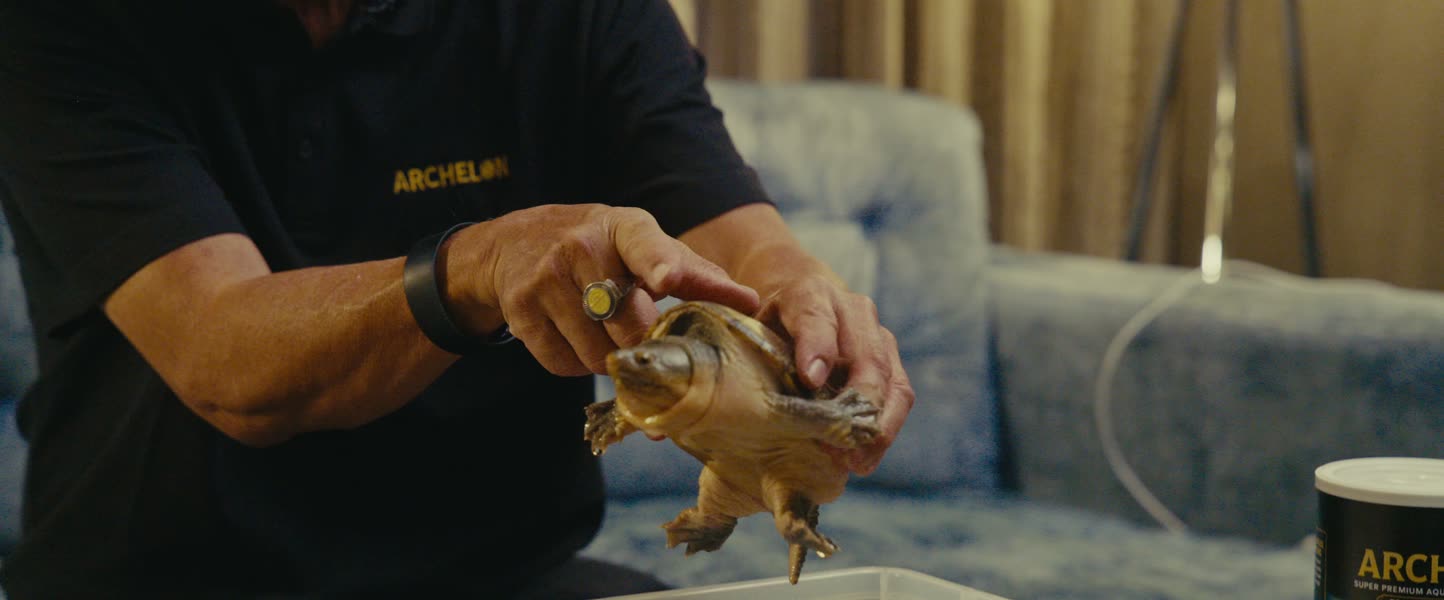
Whatever turtle you keep, the base should be a pellet made for turtles, with named animal proteins first and calcium listed above phosphorus. Archelon is one option: a 45% minimum protein pellet that leads with White Fish Meal and includes shrimp meal, krill meal and black soldier fly larvae, with a stated 3:1 calcium-to-phosphorus ratio. It floats, so read the next section before you decide whether it suits your turtle. Everything is on the full label.
Bottom feeders and floating food
This is the practical problem with these turtles. They forage on the bottom (Animal Diversity Web), and most floating turtle pellets, Archelon included, sit at the surface. Some musk and mud turtles learn to take food from the top; others don't bother. Mud turtles do come to the surface when food is there (Animal Diversity Web), but you shouldn't assume your turtle will.
So watch your own turtle:
- Does it come up and eat at the surface? If it eats floating pellets readily, a floating food works fine, and you can see exactly what was eaten.
- Does it ignore the surface? Then put the food where it can reach it. Turtles eat with their heads underwater (VCA), and VCA suggests feeding in a separate container of warm water (VCA). Keep that water shallow enough that your turtle can reach the surface easily.
- Still not eating it? A sinking food may simply suit your turtle better. Our floating vs. sinking pellets guide covers the tradeoffs.
Either way, scoop out leftover food daily (VCA). Food that sinks into gravel or behind decor is easy to miss, so check corners and under furnishings.
Pellet size for small turtles
These are small turtles. Adult common musk turtles average about 100–127 mm (4–5 inches) in shell length (Animal Diversity Web), and adult eastern mud turtles average around 93 mm (Animal Diversity Web). Hatchlings are much smaller. Archelon's pellet is 3.0 mm. Whatever food you choose, watch that your turtle picks pellets up and swallows them easily. For hatchlings, see what baby turtles eat.
Foods to skip
Bread, hot dogs, lunch meat and raw grocery-store meat or chicken (VCA). VCA also advises against wild-caught fish and amphibians, and against mostly-fish diets (VCA). These turtles will eat almost any meaty scrap, which makes it easy to overdo the wrong things.
Choose the feeding location before the brand
Draw a quick map of where pellets land and where your turtle searches. Include filter flow, furnishings and places food disappears. You do not need special equipment: the useful question is whether the turtle finds and eats the meal you offered.
If it repeatedly ignores surface food, do not buy a larger container on the assumption it will learn. Compare a format it can reach, using the floating-versus-sinking checklist. A species name on a package is less useful than watching the individual animal feed.
Common questions
Can musk and mud turtles share the same diet?
Yes, broadly. Both are bottom-foraging omnivores that eat mainly small animal prey with some plants (Animal Diversity Web; Animal Diversity Web), and VCA's feeding guidance covers both (VCA).
Are snails safe for my musk turtle?
Snails are on VCA's list of suitable foods (VCA). Use snails from a known feeder source rather than garden snails or pest snails from another tank, since you can't know what they've been exposed to. Treat them as an extra, not a calcium plan.
My turtle only wants live food. What now?
Keep offering pellets on a consistent schedule and use live foods as occasional extras rather than daily replacements. Our switching turtle food guide walks through changing diets.
My musk or mud turtle stopped eating. Is it the food?
Maybe not. A change in appetite can have many causes, so if it lasts, or comes with swelling, breathing trouble or shell changes, see a reptile vet.
Sources: Animal Diversity Web, University of Michigan: Sternotherus odoratus and Kinosternon subrubrum; VCA Animal Hospitals, "Feeding Aquatic Turtles"; Merck Veterinary Manual, "Nutrition in Turtles"; Archelon package label.
Written by Archelon Editorial. How we research these guides. General feeding information; individual needs vary by species, age and health.